Missed early vaccines tied to folks later skipping measles photographs
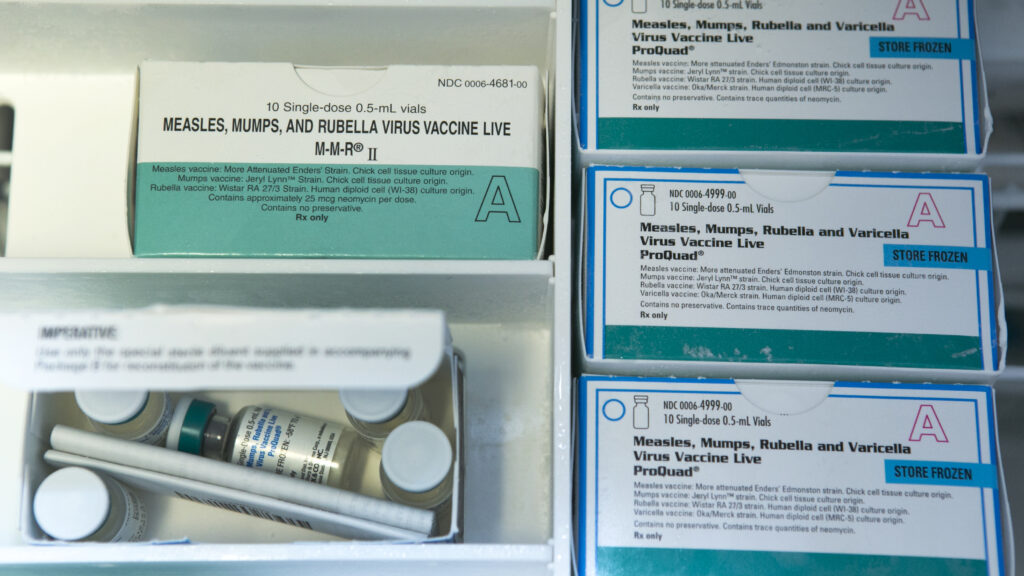
Infants who don’t get their first spherical of vaccines on time at 2 months of age are a lot much less prone to get vaccinated in opposition to measles, mumps, and rubella by age 2, in accordance with a brand new research that implies pediatricians could have a slim window wherein to influence dad and mom to observe the really helpful childhood vaccination schedule.
The research, revealed Friday in JAMA Community Open, experiences that within the post-Covid-19 pandemic interval, infants who didn’t get their photographs on time at 2 months — the age at which the Facilities for Illness Management and Prevention recommends infants get vaccines in opposition to a number of ailments — had been greater than seven instances extra doubtless to not obtain their first measles, mumps, and rubella (MMR) shot by age 2, which is months later than when that shot is meant to be given. Infants are presupposed to get their first MMR shot between 12 months and 15 months of age, with a second someday between the ages of 4 and 6.
“There’s proof from this research that very early vaccination delays result in later vaccination delays and even missed vaccination for measles,” mentioned Nina Masters, an epidemiologist who’s the lead creator of the paper. “This reveals that hesitancy is de facto beginning early and has a protracted arc.”
“And as we take a look at a extremely unhealthy measles 12 months, it’s actually vital to do no matter we are able to to attempt to enhance measles vaccination protection.”
The CDC reported this week that as of Dec. 30, the U.S. had registered 2,065 confirmed measles instances in 2025, probably the most in a single 12 months in additional than three many years. There are considerations that a number of the present instances are linked to an outbreak that was first detected in West Texas final January — a undeniable fact that, if confirmed, would set the nation on the trail to dropping its measles elimination standing someday early this 12 months.
The research is predicated on digital well being information knowledge maintained by Truveta, a well being care knowledge analytics firm owned and ruled by 30 well being programs. Truveta’s knowledge pool incorporates well being care utilization info for about 120 million people — a few third of the nation.
Masters is a senior utilized analysis scientist at Truveta. She and her co-authors studied de-identified well being care knowledge for about 322,000 youngsters born between 2017 and 2023 who acquired common care from a well being care system within the Truveta community, taking a look at vaccination patterns inside their first two years of life.
The discovering that youngsters whose earliest photographs are delayed are prone to get subsequent photographs later than really helpful — or by no means — isn’t new; earlier research have additionally proven this.
“A powerful predictor of future vaccination is having acquired any vaccine previously,” mentioned Noel Brewer, a professor of well being habits on the College of North Carolina. Brewer was a member of the CDC’s vaccine advisory panel till well being secretary Robert F. Kennedy Jr. fired the complete committee final June and appointed individuals who share his vaccine skepticism to it of their place.
However the interval studied within the paper ranged from 2018 to 2024, which allowed the researchers to search for modifications that may have occurred after the Covid-19 pandemic started. Declines in vaccination charges because the pandemic have been related to a rise in mistrust of public well being authorities and resentment over Covid containment measures.
Over the entire interval, 78.4% of the youngsters acquired their first MMR shot on time, 13.9% acquired it late, 1% acquired it early, and 6.7% didn’t obtain it by 2 years of age.
However the researchers did certainly see a dip within the charge of kids who acquired their first dose of MMR vaccine on time. It declined by three proportion factors between 2021 and 2024, Masters famous. “It’s a reasonably substantial drop in three years.”
Notably, the proportion of kids who acquired the MMR shot late remained comparatively fixed through the interval of the research. What modified was the proportion of kids who hadn’t acquired a primary MMR dose by age 2. That determine rose from 5.3% in 2020 to 7.7% in 2024. “It wasn’t that extra folks had been delaying. It was that extra folks weren’t getting the MMR vaccine [for their babies] in any respect by 2 years,” she mentioned.
The most important indicator of whether or not youngsters would obtain their first dose of MMR vaccine on time got here very early within the vaccination course of — whether or not infants acquired these vaccines that had been really helpful at 2 months outdated on time.
Vaccination in opposition to a number of pathogens begins with a go to to the pediatrician at 2 months of age, when the CDC recommends infants be immunized in opposition to hepatitis B, rotavirus, diphtheria, tetanus, pertussis, polio, Haemophilus influenzae kind b, and pneumococcal illness. (This doesn’t contain eight separate inoculations; when doable, pediatricians use multivalent vaccines that defend in opposition to 5 – 6 of those ailments with a single shot.)
Masters mentioned that the findings counsel pediatricians ought to start speaking with dad and mom concerning the significance of vaccinating — and vaccinating on time — earlier than the appointment at 2 months.
“The three largest influences on vaccination are previous vaccine receipt, desiring to vaccinate, and a health care provider’s suggestion,” mentioned Brewer, who was not concerned within the research. “Probably the most promising avenue for intervention is a health care provider’s suggestion.”
The American Academy of Pediatrics recommends frequent contact between pediatricians and infants early within the youngsters’s lives. These visits embody throughout the first week, at 1 month and a couple of months of age, and once more at 4 months, 6 months, and 9 months.
Research present that one of the simplest ways to influence dad and mom to vaccinate their youngsters is to have them obtain a suggestion from a trusted medical practitioner. However with a number of photographs scheduled for the 2-month go to, there isn’t a variety of time for pediatricians to determine a relationship of belief with the dad and mom of a brand new affected person, Masters mentioned.
“So it does create this window of alternative that’s fairly brief and places the onus, I feel, on these pediatricians actually to speak about vaccines early, construct belief early, construct training [and] familiarity proper off the bat. Don’t watch for that 2-month go to, when the mum or dad would possibly decline or delay, however actually do it immediately,” she mentioned.
Including to that problem is the truth that many infants don’t see pediatricians on that really helpful schedule. The research discovered that throughout the cohort studied, slightly below half the infants noticed their medical suppliers in accordance with the AAP’s schedule. And these had been infants with a medical house, the research famous. That they had a pediatrician. Their dad and mom had medical health insurance. The numbers had been in all probability decrease nonetheless, Masters mentioned, amongst youngsters whose dad and mom didn’t have insurance coverage or who hadn’t managed to register with a pediatric apply.
“I feel it’s conservative,” she mentioned of the findings. “I feel if we had a method to take a look at the dad and mom that aren’t bringing their youngsters in, that aren’t vaccinating their youngsters, that don’t have a medical house — which we don’t have the power to do — we’d doubtless see decrease protection, decrease timeliness, simply generally decrease alternatives for intervention to get youngsters again on observe as soon as they fall off the schedule.”
Brewer mentioned most kids obtain some vaccines, however a willingness on the a part of dad and mom to deviate from the really helpful schedule for some photographs is often an indication of issues to come back.
“Individuals who skip one vaccine usually tend to skip different vaccines,” he mentioned. “Solely round 2% of individuals won’t ever get any vaccines. So most individuals get most vaccines. However the individuals who don’t get some vaccines are additionally much less prone to get others.”
Masters famous the paper doesn’t seize any impression of the modifications to vaccination coverage which have occurred since Kennedy — a longtime proponent of disproven claims concerning the security of vaccines — was named because the nation’s prime well being official.
Amongst these modifications: an early December resolution by the CDC’s vaccine advisory committee to jettison a 30-plus 12 months suggestion that each one infants be supplied hepatitis B vaccination inside 24 hours of beginning. It now recommends at-birth vaccination just for infants whose moms examined optimistic for hepatitis B throughout being pregnant or whose take a look at standing is unknown. Different infants ought to start hepatitis B vaccination — if their dad and mom need it — at 2 months of age, the CDC now recommends.
Masters mentioned she and her colleagues are contemplating attempting to take a look at the implications of the hepatitis B vaccine modifications.